
What’s a Runoff?
How Runoffs Work
in Texas
Most people know what a general election is. Fewer know what a runoff is or why it matters. Here's everything you need to understand the May 26 runoff -- no political background required.
May Matters is nonpartisan. We don't support or oppose any candidate, party, or political position. Our only goal is to help more Texans show up informed and prepared.
How Texas elections work.
Texas elections happen in three rounds. Think of it like a tournament: you have to advance through the early rounds before the final. The runoff is round two -- and it's often the one that decides who wins.
Multiple candidates compete within each party. To win outright, a candidate needs more than 50% of the vote. If nobody clears that bar, the top two move on.
The top two candidates from March face off again. This time, whoever gets the most votes wins the party's nomination. Turnout drops -- so every vote carries more weight.
The runoff winners from each party face off in the general election. In many Texas districts, the party primary winner almost always wins in November -- making the runoff the election that counts most.
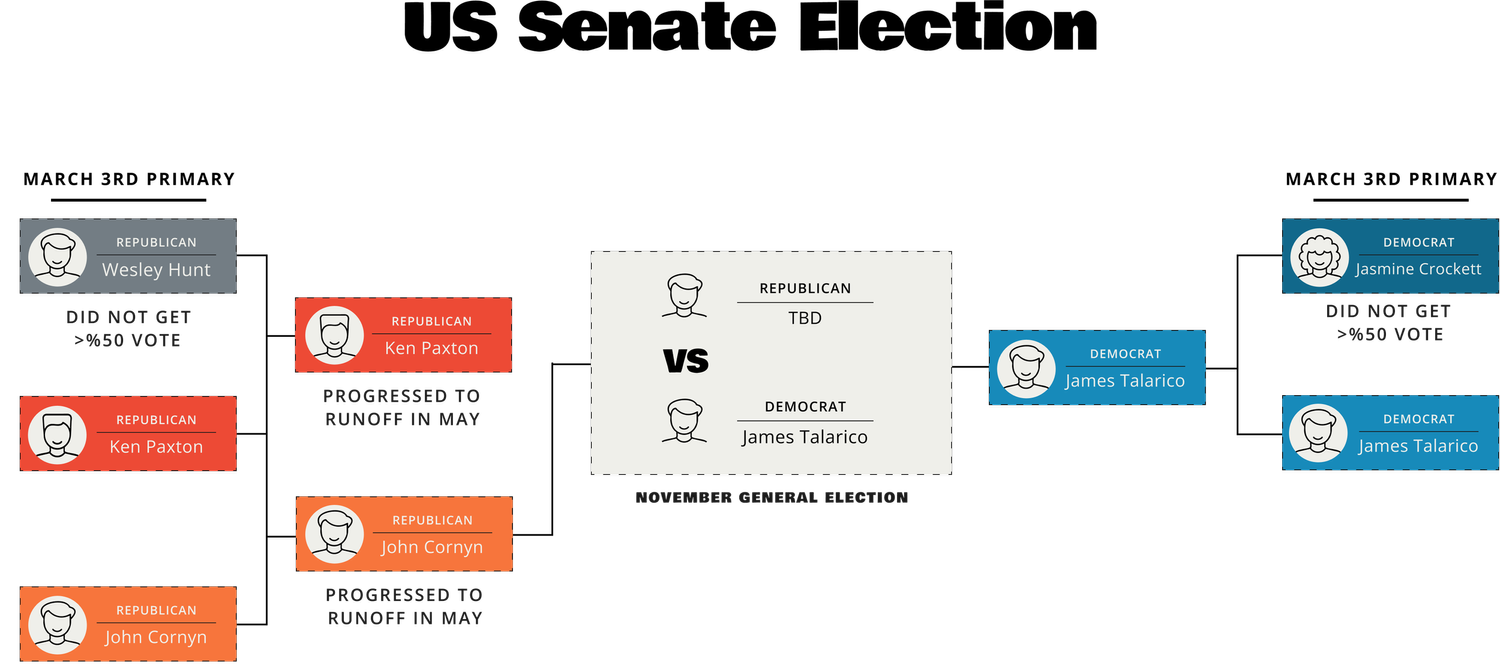
Why 50% matters.
In most elections, whoever gets the most votes wins. Texas primaries are different. A candidate has to win more than 50% of the vote -- not just a plurality. That one rule is why runoffs exist.
Here's a simple example: say five candidates are running in a primary. The top candidate gets 35% of the vote. That's the most of anyone -- but it's not 50%. So the top two candidates go to a runoff and face off again, head to head. Winner takes all.
Why does this rule exist? The 50% threshold ensures that the winning candidate has majority support within their party -- not just a plurality in a crowded field. It's a fairness mechanism. The tradeoff is that it creates a second election most people don't know about.
Want to understand what's actually at stake this May? See why the May 26 runoff matters →
Who can vote in the runoff?
Your eligibility depends on whether you voted in the March primary -- and if so, which party's ballot you voted on. Here's how it works.
You can vote in your party's runoff. If you voted the Republican ballot in March, you vote in the Republican runoff. Same goes for Democratic. No extra steps needed.
Good news -- you're still eligible. You haven't committed to a party yet, so you can choose either party's runoff ballot when you show up on May 26.
The voter registration deadline is April 27. It takes about five minutes. Check your status or register at VoteTexas.gov.
Texas does not have formal party registration. Your "party affiliation" for runoff purposes is determined by which primary ballot you voted in March. If you didn't vote in March, you're a free agent. For official eligibility guidance, visit VoteTexas.gov.
Quick answers.
Still have questions? Here are the ones we hear most often.
Do I have to pick a political party to vote in the runoff?
Not exactly. Texas doesn't require you to register with a party. But if you voted in the March primary, you voted on either a Republican or Democratic ballot -- and you can only vote in that same party's runoff. If you skipped the March primary, you can choose either party's runoff ballot on May 26.
What if I voted in March but want to vote in the other party's runoff?
Under Texas law, if you voted in one party's March primary, you can only vote in that same party's runoff. Voting in the other party's runoff after participating in a different party's primary is not permitted.
Is early voting available for the runoff?
Yes. Early voting for the May 26 runoff runs May 18-22. You can find your early voting location and hours at VoteTexas.gov.
Can I vote by mail in the runoff?
You may be eligible to vote by mail if you are 65 or older, have a disability or illness, will be away from your county during the entire early voting period and on Election Day, or are confined in jail. The mail ballot application deadline is May 15. More info at VoteTexas.gov.
Does every race have a runoff?
No. A runoff only happens when no candidate in a primary race received more than 50% of the vote. Some races are decided in March. Others go to a runoff in May. The number of runoff races varies by election cycle. In 2026, over 30 state and federal races are headed to a May runoff.
Is May Matters telling me who to vote for?
Never. May Matters is a nonpartisan civic education initiative. We don't support or oppose any candidate, party, or political position. Our only goal is making sure more Texans have the information they need to participate -- however they choose.