

In the Know:
Primary Elections & Political Parties in Texas
Your Guide to Voting in Texas Elections
Texas elections can feel complicated, especially when it comes to understanding the difference between primary elections and general elections, and how political parties fit into each.
This guide explains how elections work in Texas, including what primaries are, how general elections differ, and what it means to choose a party ballot. The goal is to provide clear, nonpartisan information so you can understand the process and make informed choices about participation.

What is a
General Election?
A general election is a regularly scheduled election where voters choose who will hold public office. It is different from a primary election, where political parties pick which candidates will appear on the general election ballot.
In the U.S. and Texas:
General elections are held on a fixed schedule set by law.
For federal offices (U.S. House, U.S. Senate, and President), this is the Tuesday after the first Monday in November of even-numbered years.
In Texas, general elections for statewide and local offices also take place in November of even-numbered years. For example, the 2026 Texas gubernatorial general election is scheduled for November 3, 2026.
Common Ballot Items
A general election usually decides multiple offices at once:
Federal offices (e.g., U.S. House or Senate)
Statewide offices (e.g., governor or attorney general)
Local offices (e.g., county judge or school board)
Ballot measures, constitutional amendments, or local propositions.
What is a
primary Election?
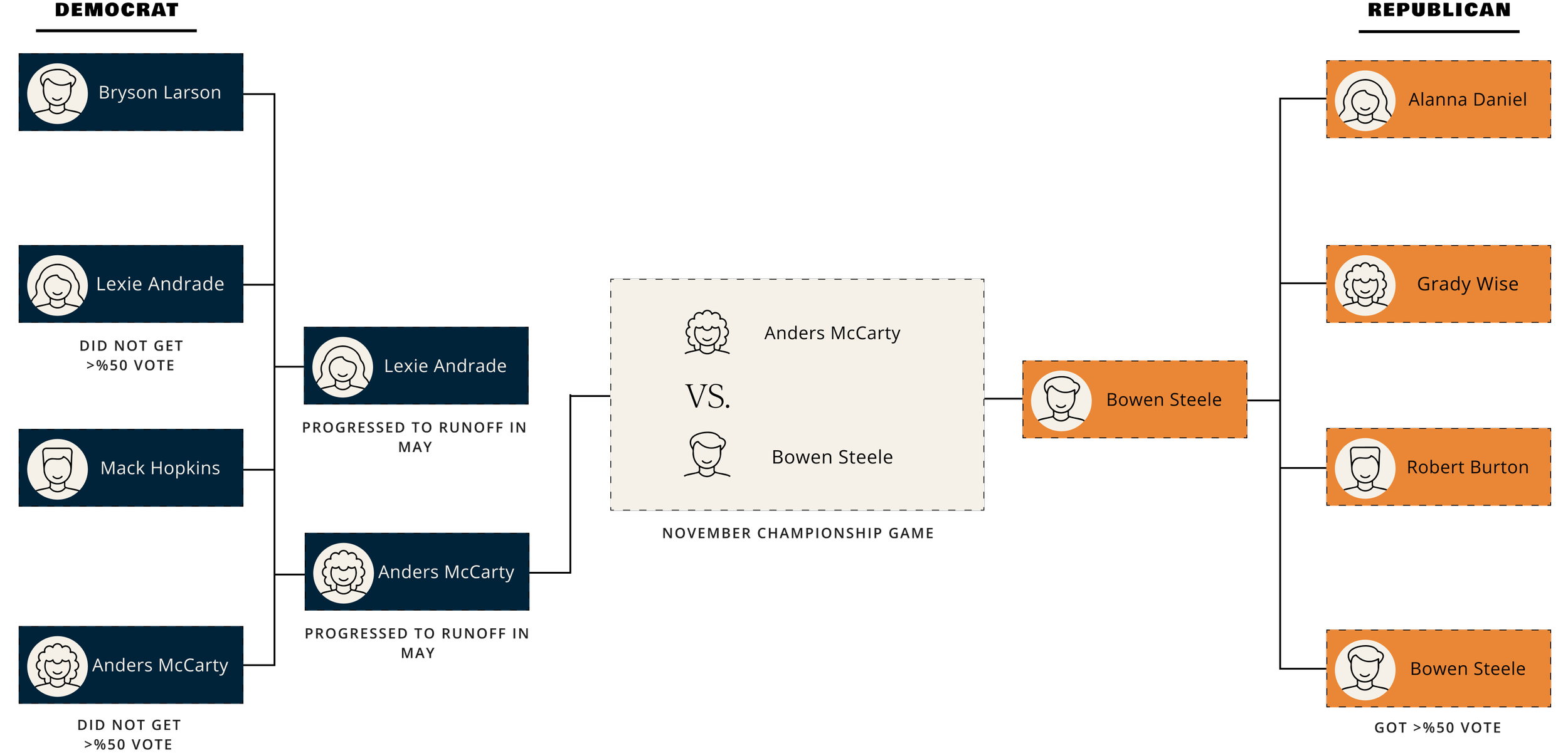
Primary elections are how political parties choose the candidate who will represent them in the November general election. They act as the “opening round” of the election cycle.
Primary elections are held earlier in the year (typically in March).
They determine which candidates each political party will nominate for the general election.
Voters choose which party’s primary they want to participate in when they arrive at the polls.
Texas party primaries
In Texas, the major parties hold their own separate elections:
Republican Primary: Voters choose which Republican candidates will move to November
Democratic Primary: Voters choose which Democratic candidates will move to November
primary vs. general
primaries decide…
Which Candidate Gets on the Ballot.
general elections decide…
which individual holds public office.
Millions of voters participate in general elections, and turnout is often higher than in primary elections.
how texas
primaries work
party affiliation
& privacy
-
No. When Texans register to vote, they don’t register with a political party. If you’re registered to vote in Texas, you may vote in either party’s primary
-
In Texas, party affiliation is temporary and limited.
When you vote in a party’s primary:
You are considered affiliated with that party for that calendar year only.
Your affiliation applies only if there is a runoff election. Then, you must vote in the runoff for the same party.
Your affiliation doesn’t affect how you vote in the general election
-
The Green and Libertarian parties select their candidates through a series of local and state conventions beginning March 10. Although you can choose to vote in any party’s primary, you can only participate in one primary or a third party’s convention.
-
Independents have the same options as all Texas voters. For the primaries, you still must pick either the Republican or Democrat ballot. This choice applies only to that specific primary election and doesn’t affect how you may vote in the general election.
-
Who you vote for is private and secret.
The fact you voted in a specific party’s primary is public record.
This means your name may appear on that party’s voting roster, and you may receive mail or ads from that party. Your individual vote is never disclosed.